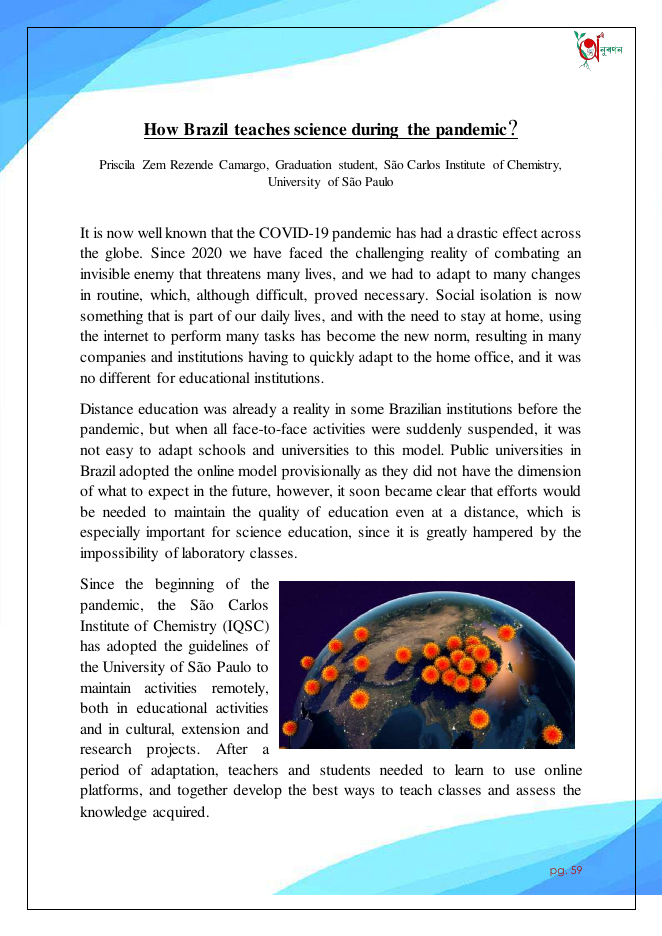
Written by a chemistry undergraduate at the São Carlos Institute of Chemistry, University of São Paulo, the piece describes how a Brazilian public university kept science teaching going after face-to-face classes were suspended in 2020. It outlines the difficulties students faced: leaving the university city at short notice, poor internet access, cramped family homes, economic hardship and the anxiety of isolation. The university responded with free internet kits (a SIM card and USB adaptor with 60 GB of monthly data), loaned laptops, online library collections, psychological support, training for teachers in online platforms and, later, online laboratory classes in which the professor performs the experiments while students write up the reports.
Three students, including the author, give first-hand accounts of distraction, uncoordinated deadlines and the impossibility of doing organic synthesis at home, but also of better time management through recorded classes and of supportive teachers. With vaccination reaching about half the population, schools and research activities are returning, and the university is considering hybrid teaching as a lasting legacy of the period.