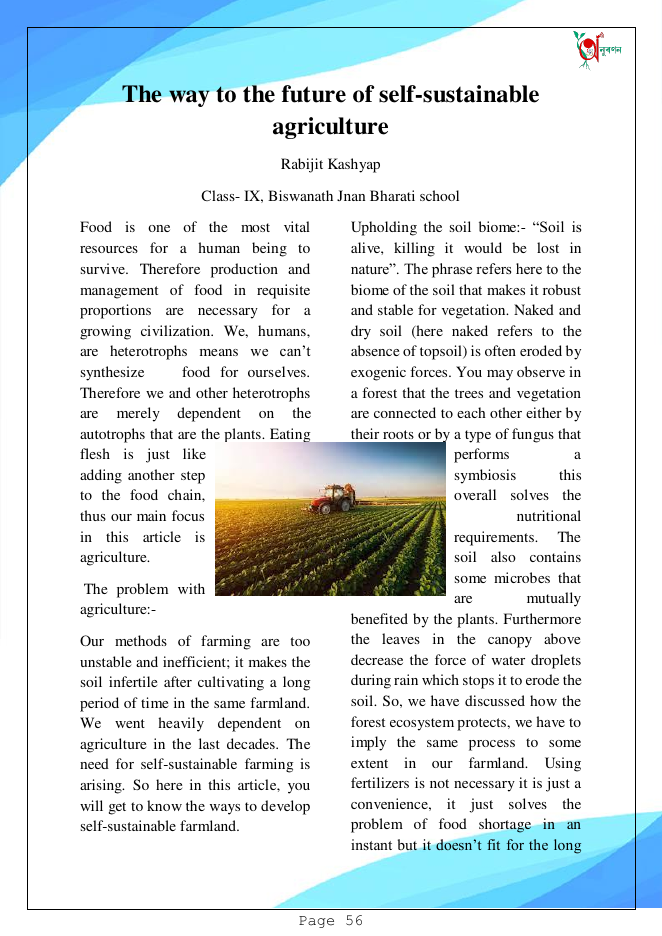
Written for the children's section by a Class IX student, this piece sets out practical ways of making farmland self-sustaining rather than dependent on fertilisers. It argues that current farming methods exhaust the soil after long cultivation, and that the answer lies in keeping the soil biome alive, as a forest does through interlinked roots, fungi and a protective canopy. Several soil organisms are described in turn: mycorrhizal fungi, whose fine hyphae extend the reach of plant roots and trade minerals for sugar; nitrogen-fixing bacteria such as Rhizobium in legumes and Gluconacetobacter diazotrophicus in sugarcane; nitrifying comammox bacteria; denitrifiers; and earthworms, which loosen and enrich the soil.
Cover crops such as cabbage, wheat, barley and oats are recommended to protect bare land from erosion and weeds, and growing a variety of plants together is said to give better defence against pests than a single crop. The article closes with no-till or zero-till farming, in which harvested stems are left to decompose into humus instead of the soil being ploughed; the idea is credited to Edward H. Faulkner in the 1940s, first demonstrated in the United States in 1961-62, and is now promoted through subsidies and training by the Indian government.